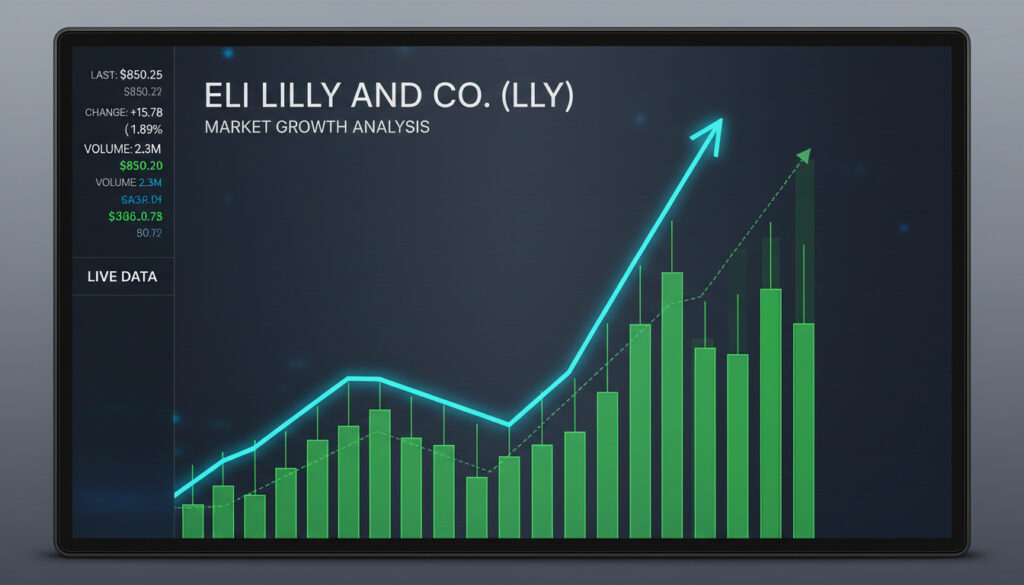
Eli Lilly Stock Price – Live Data, Charts and Forecast
Eli Lilly and Company (NYSE: LLY) closed the most recent trading session on April 6, 2026, between $920 and $935 per share, reflecting intraday volatility that saw prices swing from lows near $919 to highs approaching $944. The pharmaceutical giant, currently valued between approximately $776 billion and $876 billion, continues to attract significant investor attention as its GLP-1 receptor agonists Mounjaro and Zepbound reshape the metabolic disease treatment landscape.
Recent sessions have captured the tension between bullish long-term growth narratives tied to obesity and diabetes treatments and near-term technical pressure that has pushed the stock into corrective territory. With shares trading well below the August 2024 all-time high of $972.53, market participants are weighing quarterly earnings surprises against broader sector rotation patterns.
The stock’s current beta of 0.64 indicates lower systematic risk than the broader market, though recent volatility readings of 1.89% demonstrate heightened sensitivity to drug trial announcements and FDA regulatory updates.
What is the Current Eli Lilly (LLY) Stock Price?
Key Insights at a Glance
- Session Range: Intraday lows reached $919.82 with highs touching $938.68 on April 6, 2026.
- Market Cap Spread: Valuation varies between $776.19 billion and $875.67 billion depending on calculation methodology and share count.
- Dividend Yield: Current yield stands between 0.67% and 0.73%, maintaining consistent quarterly distributions.
- Earnings Trajectory: TTM basic EPS of $15.11 supports a P/E ratio between 40.76 and 54.80.
- Volatility Profile: Beta of 0.64 suggests defensive characteristics, though recent volatility of 1.89% exceeds historical norms.
- Volume Divergence: Recent session volume of 686,928 (official) to 1.82 million (retail platforms) falls below the 3.28 million average.
- Net Income: Fiscal year net income reported at $10.59 billion according to TradingView fundamentals.
Snapshot: Critical Metrics
| 52-Week High | $1,133.95 | Robinhood |
| 52-Week Low | $623.78 | Robinhood |
| All-Time High | $972.53 (Aug 22, 2024) | TradingView |
| P/E Ratio (TTM) | 40.76 – 54.80 | Robinhood |
| EPS (TTM, Basic) | $15.11 | TradingView |
| Beta | 0.64 | TradingView |
| Dividend Yield | 0.67% – 0.73% | Robinhood |
| Net Income (FY) | $10.59B | TradingView |
| Volatility | 1.89% | TradingView |
| Previous Close | $935.58 | Lilly Investor Relations |
How Has Eli Lilly Stock Performed Recently?
Near-Term Pressure Points
The stock established an 18-week low of $956.91 on March 17, 2026, representing a 7.45% decline over the preceding four weeks. This technical breakdown followed an earlier 4-week low of $1,000 recorded on March 3, 2026, indicating sustained selling pressure through the first quarter.
Real-time quotes vary across platforms due to timestamp differences and after-hours trading. Investing.com displayed $639.43 in potentially delayed or currency-adjusted data, while primary U.S. exchanges recorded $920-$936 ranges. Investors should prioritize official investor relations data for execution decisions.
Monthly Contradictions
Performance metrics diverge significantly based on calculation windows. TradingView data indicates a +13.25% rise over the past month, while TradingEconomics recorded 4-week losses between 7.45% and 12.88% during overlapping periods. This discrepancy highlights the volatility of late March and early April sessions.
Annual Context
Year-over-year returns range from -8.36% to +16.26% depending on the source and exact comparison date. The stock remains significantly below its 52-week high of $1,133.95, though well above the $623.78 annual low. All-time historical context shows the current price near $927 represents substantial appreciation from the $2.04 all-time low recorded in 1977.
What is the Eli Lilly Stock Forecast and Analyst Outlook?
Price Target Dispersion
Analyst consensus establishes a wide valuation range, with maximum price targets of $1,190 and minimum targets of $700. TradingEconomics modeling predicts $851.89 for Q1 2026 and $777.50 on a 12-month horizon, suggesting potential downside from current levels.
Recent Rating Revisions
FINVIZ data captures two significant downgrades during August 2025. Daiwa Securities shifted coverage from Outperform to Neutral on August 18, 2025, assigning a $700 target. Leerink Partners followed on August 7, 2025, downgrading from Outperform to Market Perform with a $715 target. These revisions introduced bearish sentiment during the summer consolidation period.
Options Market Indicators
Derivative markets show positioning for volatility around the October 31, 2025 expiration, with $850 call options indicating 24% return potential if the stock recovers toward strike levels. This activity suggests institutional hedging against both downside risk and upside gaps.
Why Is Eli Lilly Stock Price Moving?
Earnings Surprises vs. Consensus
The company reported Q4 2025 earnings of $7.54 per share on February 4, 2026, exceeding the $7.16 consensus by $0.38. This followed a Q3 2025 beat of $7.02 against $6.36 expectations. The upcoming Q1 2026 release scheduled for April 30, 2026, carries a consensus estimate of $7.25, with previous quarter comparisons at $3.34.
Four consecutive quarters of earnings beats demonstrate operational momentum, with Q4 2025 representing a 41% sequential increase from Q3’s $5.32. This trajectory supports premium valuation multiples despite recent price weakness.
GLP-1 Portfolio Dynamics
TradingView technical analysis notes bearish pressure correlating with market resets in GLP-1 sentiment, though bullish flag patterns may emerge if resistance at $972-$973 breaks. Mounjaro and Zepbound remain the fundamental revenue drivers, with the stock’s valuation tethered to prescription growth rates and insurance coverage expansions for obesity indications.
Analyst downgrades from Daiwa and Leerink cite valuation concerns and competitive pressures from Novo Nordisk. Technical analysis identifies critical support at $720-$709; failure to hold current levels could trigger a bearish correction toward $35-$17 in extreme scenarios, though such targets represent outlier technical views.
A sustained breakout above $972-$973 resistance could activate a bullish flag pattern targeting $1,250+. This level corresponds with the August 2024 all-time high zone and represents the threshold for trend reversal confirmation.
Key Events in Eli Lilly’s Market Timeline
- : Stock reaches all-time high of $972.53, establishing the current resistance ceiling.
- : Leerink Partners downgrades LLY to Market Perform with $715 target.
- : Daiwa Securities shifts rating to Neutral, setting $700 price target.
- : Q3 2025 earnings release beats consensus by $0.66 per share.
- : Q4 2025 earnings of $7.54 exceed $7.16 estimates.
- : 4-week low established at $1,000.00.
- : 18-week low of $956.91 recorded amid broad market weakness.
- : Current session closes in $920-$935 range, down 1-2%.
- : Scheduled Q1 FY2026 earnings release with $7.25 consensus.
What Is Certain and Uncertain About Eli Lilly’s Trajectory?
| Established Facts | Remaining Uncertainties |
|---|---|
| Q4 2025 earnings of $7.54 and Q3 2025 of $7.02 with specific consensus beats. | Whether Q1 2026 results will meet, exceed, or fall short of the $7.25 consensus. |
| FDA-approved GLP-1 drugs Mounjaro and Zepbound generating current revenue streams. | Timing of additional FDA approvals for expanded indications and long-term patent protection. |
| Specific downgrades from Daiwa ($700 target) and Leerink ($715 target) in August 2025. | Duration of competitive pressure from Novo Nordisk and other pipeline entrants. |
| Historical price data: 52-week low $623.78, high $1,133.95; all-time high $972.53. | Technical breakout timing above $972-$973 resistance or breakdown below $709 support. |
Understanding Eli Lilly’s Market Position
Eli Lilly occupies a dominant position in the metabolic disease therapeutic sector, with a market capitalization exceeding $775 billion placing it among the largest global pharmaceutical enterprises. The company’s strategic concentration on glucagon-like peptide-1 (GLP-1) receptor agonists differentiates its revenue model from traditional small-molecule pharmaceuticals.
Unlike diversified healthcare conglomerates or technology infrastructure plays such as Hut 8 Stock Nasdaq – Live Price, Forecast and Analysis, Lilly’s valuation remains tightly coupled to prescription volume for weight management and glycemic control therapies. This concentration creates asymmetric risk profiles where clinical trial readouts and FDA advisory committee rulings drive immediate volatility.
The stock’s defensive beta of 0.64 historically cushioned against broad market selloffs, though the recent 1.89% volatility reading suggests increased correlation with speculative growth names. Understanding these dynamics requires monitoring both Paralysie Budgétaire États-Unis – Causes, Impacts, Timeline for macroeconomic context and sector-specific catalysts.
Data Sources and Verification
Real-time stock data provided by LSEG with a minimum 15-minute delay. Official SEC filings including 10-K, 10-Q, and 8-K reports are maintained through the investor relations portal.
— Eli Lilly Investor Relations
Valuation models incorporate dividend sustainability metrics and pipeline net present value calculations for metabolic and oncology portfolios.
— Morningstar Equity Research
Summary: Eli Lilly Investment Considerations
Eli Lilly trades near $927 as of April 6, 2026, representing a session decline of approximately 1-2% and year-over-year performance ranging from -8% to +16% depending on measurement endpoints. The stock remains 15% below its August 2024 all-time high despite consecutive earnings beats in Q3 and Q4 2025. With analyst targets spanning $700 to $1,190, the upcoming April 30 earnings release represents the immediate catalyst. For investors evaluating technology sector alternatives, see our analysis of Hut 8 Stock Nasdaq – Live Price, Forecast and Analysis.
Frequently Asked Questions About Eli Lilly Stock
What is Eli Lilly’s ticker symbol and exchange?
Eli Lilly trades on the New York Stock Exchange under the ticker symbol LLY.
Does Eli Lilly pay a dividend?
Yes, the current dividend yield ranges between 0.67% and 0.73% according to recent data from financial platforms.
What are Eli Lilly’s primary revenue-driving drugs?
Mounjaro (tirzepatide) for type 2 diabetes and Zepbound for chronic weight management currently drive fundamental investor interest and revenue growth.
When is the next Eli Lilly earnings report?
The company is scheduled to report Q1 FY2026 earnings on April 30, 2026, with consensus estimates of $7.25 per share compared to $3.34 in the previous year quarter.
What is Eli Lilly’s 52-week trading range?
The stock has traded between $623.78 (low) and $1,133.95 (high) over the past 52 weeks, with an all-time high of $972.53 reached on August 22, 2024.
How do I access official Eli Lilly SEC filings?
All SEC filings including 10-K, 10-Q, and 8-K reports are accessible through the investor relations website.
More related posts
 Selena Gomez Weight Loss – Journey, Diet and Health Facts
 Kedar Williams-Stirling – Age, Height, Sex Education Bio
 Has Amelia Earhart’s Plane Been Found? Latest Evidence
 Blue Jays vs Dodgers 2025 – Schedule, Scores and Key Moments
 BMO Online Banking Login – Step-by-Step Guide and Fixes
 Can Dogs Have Cherries – Risks, Safety and Vet Advice
 Best Italian Restaurants Vancouver: Michelin & TripAdvisor
 Xbox Game Pass PC – Price, Games and Setup Guide