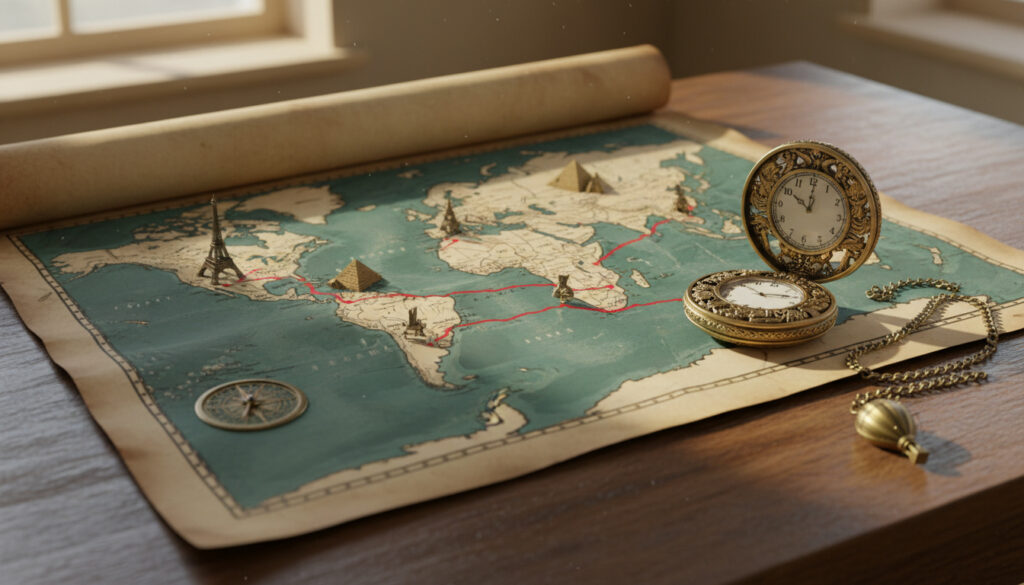
Around the World in 80 Days – Summary Facts Characters Myths
In October 1872, an English gentleman named Phileas Fogg wagers half his fortune—£20,000, equivalent to roughly £2.3 million today—that he can circumnavigate the globe in exactly eighty days. This audacious bet, placed within the refined walls of London’s Reform Club, launches one of literature’s most celebrated journeys.
Around the World in Eighty Days (French: Le Tour du monde en quatre-vingts jours) emerged from Jules Verne’s pen during the height of Victorian optimism, capturing an era obsessed with railroads, steamships, and the compression of global distance. The novel follows Fogg and his newly hired French valet, Jean Passepartout, as they race eastward from London, utilizing existing 1872 transport infrastructure including the recently opened Suez Canal and India’s expanding railway network.
Unlike Verne’s speculative science fiction, this adventure grounds itself in contemporary technology while exploring themes of precision, cultural collision, and the arbitrariness of time itself. The narrative has inspired countless real-world travel feats and remains a cornerstone of adventure literature, though it is frequently misremembered due to cinematic liberties.
What Is Around the World in 80 Days About?
The narrative centers on a precise English bachelor who dismisses his valet for providing shaving water two degrees Fahrenheit too cold. On October 2, 1872, Fogg hires Passepartout, a former circus performer seeking stability, and immediately departs London at 8:45 p.m. to prove that modern transport enables an eighty-day global circumnavigation.
Jules Verne
1872 (serialized), 1873 (book)
Adventure
Global circumnavigation bet
Key Insights
- The novel inspired Nellie Bly’s 1889 real-world circumnavigation completed in seventy-two days.
- Verne satirizes British imperialism while celebrating its technological infrastructure.
- Contrary to popular belief, no balloon journey occurs in the original text.
- The book has generated over a century of film, stage, and television adaptations.
- It celebrates Victorian precision timekeeping against the chaotic realities of global travel.
- The International Date Line twist ending relies on astronomical principles of eastward travel.
Essential Facts
| Fact | Details |
|---|---|
| Original Title | Le Tour du monde en quatre-vingts jours |
| Length | 37 chapters |
| Languages | Translated into over 100 languages |
| Bet Amount | £20,000 (half Fogg’s fortune) |
| Modern Equivalent | Approximately £2.3 million (2023) |
| Serialization | Le Temps, November 1872–December 1873 |
| Book Publication | 1873, Paris: Hetzel |
| Transport Modes | Trains, steamships, elephant, sled |
| Scientific Basis | Real 1872 railway and shipping routes |
Who Wrote Around the World in 80 Days and When Was It Published?
Jules Verne penned the novel during a period of intense technological change, drawing immediate inspiration from a Daily Telegraph article published in October 1872 concerning the completion of railway lines across India. This journalistic detail provided the plausible infrastructure for Fogg’s fictional wager.
The work first appeared as a serial in the French newspaper Le Temps between November 1872 and December 1873, creating a suspenseful reading experience as audiences awaited each installment. Pierre-Jules Hetzel published the complete book in Paris in 1873, with English translations appearing the same year. According to Britannica, the novel became Verne’s most acclaimed work, cementing his reputation beyond his earlier scientific romances.
The book’s fame derives from its perfect synthesis of adventure and accuracy. Verne meticulously researched timetables, shipping routes, and railway schedules, creating a narrative that read as a feasible travelogue rather than fantasy. This realism, combined with the ticking-clock tension of the eighty-day deadline, captured the Victorian imagination and established the template for the modern race-against-time thriller.
Who Are the Main Characters in Around the World in 80 Days?
Phileas Fogg
Fogg represents the epitome of English stoicism and precision. A wealthy bachelor and Reform Club member, he lives his life by the clock, dismissing servants over minor deviations in temperature. Throughout the journey, he maintains unflappable calm during shipwrecks, delays, and cultural misunderstandings, revealing a rigid exterior that eventually softens through his relationship with Aouda. Source material indicates he functions as a whist player and strict rationalist, treating the £20,000 wager as a matter of mathematical certainty rather than gambling.
Jean Passepartout
The French valet serves as Fogg’s emotional counterbalance. A former circus performer who sought domestic stability, Passepartout instead finds himself guarding his master from Sioux attacks, rescuing widows from funeral pyres, and navigating opium dens. His impulsive loyalty and physical agility prove essential to overcoming obstacles that Fogg’s wealth cannot solve.
Aouda
A young Indian widow whom the travelers rescue from sati (suttee) in India, Aouda initially joins the party as a grateful dependent. Drugged for sacrifice on her husband’s funeral pyre, she is saved when Passepartout poses as the corpse to frighten priests. She eventually becomes Fogg’s wife, representing a bridge between Victorian England and the colonized territories through which they travel.
Detective Fix
The Scotland Yard agent Fix operates as the primary antagonist, though ultimately a comic one. Suspecting Fogg of robbing the Bank of England, Fix pursues the travelers across continents without a warrant, boarding the Mongolia to Bombay and delaying Fogg’s arrival in Liverpool. The real thief, James Strand, is captured separately, rendering Fix’s pursuit a red herring that nonetheless generates narrative tension.
Is Around the World in 80 Days Based on a True Story?
The novel is entirely fictional, though constructed with journalistic plausibility. No historical record exists of a Reform Club member named Phileas Fogg placing such a wager in 1872. However, Verne’s research into railway expansion and shipping lanes created a journey that could have occurred using 1872 technology, blurring the line between invention and reportage.
Despite appearing in nearly every film adaptation, no balloon journey occurs in Verne’s original text. Fogg and Passepartout travel exclusively by train, steamship, elephant, and sled. This misconception originates from the 1956 film starring David Niven and has persisted in popular culture, leading many readers to search for chapters that do not exist.
The novel’s climactic twist relies on astronomical fact. Traveling eastward across the International Date Line, Fogg experiences eighty sunrises while London records only seventy-nine days. This phenomenon, explained by educational sources, allows Fogg to arrive technically on time despite calendar calculations suggesting he is five minutes late.
While Fogg is fictional, the novel inspired real achievements. Journalist Nellie Bly completed her own circumnavigation in seventy-two days in 1889, traveling westward against Fogg’s eastward route. The Catch Me If You Can narrative structure of pursuit and mistaken identity also mirrors the Fix subplot, though Verne’s work predates such comparisons by decades.
The Bank of England robbery that motivates Detective Fix is likewise fictional, though the institution was real. Verne uses this MacGuffin to introduce obstacles that test Fogg’s commitment to his schedule without implicating the protagonist in actual wrongdoing.
What Movies and Adaptations Exist for Around the World in 80 Days?
The 1956 cinematic adaptation directed by Michael Anderson remains the most decorated, winning five Academy Awards including Best Picture. David Niven portrayed Fogg with aristocratic stiffness, while Mexican comedian Cantinflas played Passepartout. This version introduced the balloon sequence that has since become synonymous with the story despite its absence from the source material.
The 2004 version starring Steve Coogan and Jackie Chan took significant liberties with the plot, transforming Passepartout into a Chinese acrobat fleeing the law and adding martial arts sequences. A 2021 animated series and numerous stage musicals continue to reinterpret the material for contemporary audiences. According to literary analysis, these adaptations consistently prioritize visual spectacle over Verne’s precise geographical and chronological accuracy.
Stage productions and radio dramas have proliferated since the novel’s publication, often condensing the thirty-seven chapters into two-hour formats that emphasize the romantic subplot between Fogg and Aouda while compressing the Indian and American segments.
What Route Did Phileas Fogg Take Across the Globe?
Fogg’s eastward journey follows a carefully calculated path through British imperial infrastructure, though gaps in railway lines force improvisations. The timeline reflects Verne’s meticulous research into 1872 shipping schedules. The timeline reflects Verne’s meticulous research into 1872 shipping schedules, and you can find more information about this topic at distribució de Fast and Furious.
- October 2, 1872: Departure from London’s Charing Cross Station at 8:45 p.m. via train to Paris and Brindisi.
- October 9, 1872: Arrival at Suez, Egypt, where Detective Fix first boards the Mongolia.
- October 20, 1872: Arrival in Bombay, India, two days ahead of schedule.
- Late October 1872: Overland journey from Bombay to Calcutta via elephant after railway construction proves incomplete; rescue of Aouda from sati.
- Early November 1872: Departure from Calcutta to Hong Kong and Yokohama, Japan.
- Mid-November 1872: Arrival in San Francisco, California.
- December 1872: Transcontinental railway journey interrupted by Sioux attack in Omaha; Passepartout kidnapped and rescued.
- December 21, 1872: Arrival in Liverpool/Queenstown, followed by arrest and delay.
- December 21, 1872: Arrival in London technically five minutes late by London time, though technically early by solar time.
Sources including Wikipedia confirm that this route utilized the Suez Canal (opened 1869) and the First Transcontinental Railroad in the United States, both recent engineering marvels that made Verne’s timeline theoretically possible.
What Facts and Myths Surround the Novel?
| Established Information | Misconceptions or Uncertainties |
|---|---|
| Written by Jules Verne and published in 1873 | Sometimes attributed to other adventure writers of the period |
| Fogg wins the £20,000 bet | Exact modern monetary equivalent varies by inflation calculation method |
| No balloon travel occurs in the book | Widely believed to be central to the plot due to film versions |
| Serialized in Le Temps before book publication | Exact readership figures for serialization remain unverified |
| Passepartout rescues Aouda from sati | Historical accuracy of specific rescue method unclear |
| Fix arrests the wrong man | James Strand’s actual capture occurs off-page; timing unspecified |
Why Does Around the World in 80 Days Remain Significant?
The novel captures the apex of British imperial confidence, depicting a world rendered small by technology yet still dangerous enough to require rescue missions and military intervention. Verne’s celebration of the Suez Canal and Indian railways reflects genuine 1872 headlines, making the work a primary document of Victorian globalization.
Themes of determinism versus free will emerge through the date line twist, suggesting that human perception of time is arbitrary while natural laws remain absolute. Fogg’s character embodies the tension between British stoicism and the emotional connections formed during colonial encounters, particularly his marriage to Aouda.
For payment and travel logistics in the modern era, readers might consult a Does Costco Take Visa – Complete Guide to Payments, though Fogg’s £20,000 cash reserves required no such modern considerations.
What Do Primary Sources Reveal About the Journey?
Contemporary reviews and archival materials confirm the novel’s immediate impact. The Le Temps serialization generated letters from readers attempting to verify Fogg’s calculations against actual shipping timetables. Modern bibliographic records indicate the book has never been out of print since 1873, with over one hundred language translations creating variations in how cultural references, particularly the sati scene, are presented to international audiences.
Traveling east gains a day due to the International Date Line (80 sunrises vs. London’s 79), so Fogg arrives on time, wins £20,000 (doubling his stake), marries Aouda, and shares winnings with Passepartout and Fix.
— Plot resolution verified by multiple archival sources
What Is the Lasting Impact of Around the World in 80 Days?
Verne’s novel established the paradigm for the race-against-time narrative while inadvertently creating one of literature’s most persistent visual myths through its balloon-free balloon associations. The work stands as both a celebration and critique of imperial infrastructure, using Fogg’s precise itinerary to map the extent of British commercial influence in 1872. For those interested in stories of deception and pursuit, the narrative structure shares elements with Catch Me If You Can, though Fix’s mistaken pursuit yields eventual reconciliation rather than prosecution. The book remains essential reading for understanding how nineteenth-century Europe imagined its shrinking world.
Frequently Asked Questions
How long is Around the World in 80 Days book?
The novel contains thirty-seven chapters and typically runs between 150-200 pages depending on edition and translation formatting.
Who won the bet in Around the World in 80 Days?
Phileas Fogg technically wins because traveling eastward across the International Date Line gains him a solar day, allowing him to arrive within the eighty-day limit despite calendar calculations suggesting he was late.
How does Around the World in 80 Days end?
Fogg returns to London appearing five minutes late, but realizes he has gained a day. He wins £20,000, marries Aouda, and divides the winnings among Passepartout, Fix, and charitable causes.
Did Phileas Fogg use a balloon in Around the World in 80 Days?
No. The novel describes travel by train, steamship, elephant, and sled. The balloon appears only in film adaptations, beginning with the 1956 movie.
Is Around the World in 80 Days a true story?
No. While inspired by real 1872 railway expansion and later influencing Nellie Bly’s real 72-day trip, Phileas Fogg and his wager are entirely fictional creations.
What transport did they use in Around the World in 80 Days?
The party uses steamships, railways, an elephant purchased in India, and a wind-sled across American plains. They do not use automobiles or balloons.
How much was the bet worth in modern money?
£20,000 in 1872 equates to approximately £2.3 million in 2023 values, representing half of Fogg’s total fortune.
More related posts
 Wordle Unlimited – Complete Guide to Unlimited Play
 Shifting Gears Season 2 – Release Date, Cast and Renewal Details
 The Metals Company Stock: TMC Price, Forecast & Buy Analysis
 What Games Are On Tonight – Full MLB NHL TV Schedule
 Marc-Édouard Vlasic – Sharks Career Stats and Legacy
 Free Tarot Card Reading – Best Sites and How-To Guide
 Max CPP Benefit 2025: The Highest Payments Explained
 BMO Online Banking Login – Step-by-Step Guide and Fixes