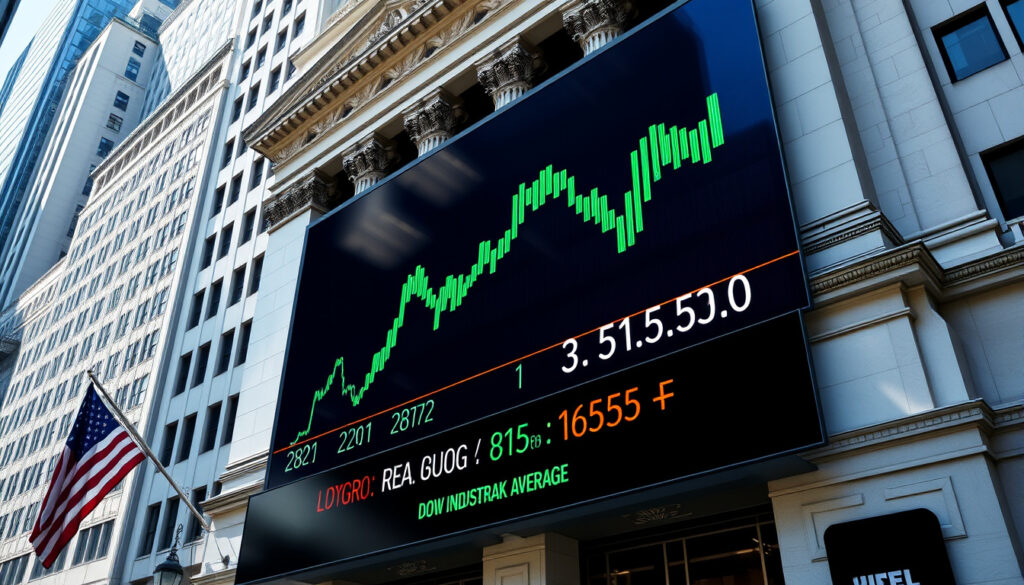
Dow Jones Today Live – Current Value, Chart & Updates
What Is the Current Dow Jones Value and Performance Today?
The Dow Jones Industrial Average (DJIA) remains one of the most closely watched barometers of U.S. stock market health, providing investors with real-time insight into how the 30 largest American companies are performing. Recent trading sessions have shown the index navigating a period of heightened volatility as markets digest economic data, Federal Reserve signals, and geopolitical developments.
Market data across major financial platforms shows the index recently trading in the 47,900 to 48,200 range. According to figures from Investing.com, the DJIA stood at 47,916.33, while IG reported a reading of 47,932.6. The most recent complete session showed a high of 48,323.95 and a low of 47,690.27, with the opening at 47,840.63, according to data compiled by Business Insider and the New York Stock Exchange.
The 30-day performance stands at +2.62%, though the 90-day picture shows a decline of 3.41%. Historical data reveals the index reached a 250-day high of 50,512.79 while dipping to a low of 45,057.28 over the same period, according to Investing.com. Technical indicators from one platform suggest a “strong sell” signal, reflecting uncertainty among algorithmic trading models.
- War-fueled inflation concerns have weighed on sentiment, with analysts suggesting potential continued pressure over the coming months
- Sector rotation has favored technology names, with NVIDIA and Amazon posting notable gains despite broader market weakness
- The Federal Reserve’s cautious stance on oil price shocks continues to influence market expectations
- Average trading volume over three months sits at approximately 337.7 million shares, indicating active market participation
- Year-to-date growth stands at approximately +17.4% according to one report from Investing.com
Current values reflect the last closing and intraday data available. Live trading occurs only during NYSE hours from 9:30 AM to 4:00 PM ET on weekdays. Early Saturday morning UTC means no active market session is in progress.
Key Performance Metrics Snapshot
| Metric | Value | Period |
|---|---|---|
| Current Level | ~47,932 | Latest reading |
| 30-Day Performance | +2.62% | Past month |
| 90-Day Performance | -3.41% | Past quarter |
| 250-Day High | 50,512.79 | |
| 250-Day Low | 45,057.28 | |
| Average Volume | 337,657,861 shares | 3-month average |
Where to Find Dow Jones Live Chart and Ticker?
Investors seeking real-time visualization of the Dow Jones Industrial Average have several reputable platforms at their disposal. Major financial data providers offer interactive charts that display price movements, volume data, and technical indicators. These tools allow users to identify trends, support and resistance levels, and potential entry or exit points based on historical patterns.
The New York Stock Exchange provides official quote data for the DJIA, while platforms like Investing.com and Business Insider offer comprehensive real-time tracking with customizable timeframes. Traders can access intraday charts, daily, weekly, and monthly views to suit different investment strategies.
For those interested in broader market context, comparing the Dow Jones against other indices provides valuable perspective. While the DJIA tracks 30 price-weighted large-cap companies, the S&P 500 encompasses 500 market-cap weighted stocks for broader coverage. According to S&P Dow Jones Indices, this structural difference means the DJIA’s narrower composition amplifies individual stock moves, particularly affecting high-priced components like Goldman Sachs.
What Are Dow Jones Futures and Premarket Levels?
Dow Jones futures contracts provide traders with indicative movements of where the index may open, serving as a valuable forecasting tool outside regular market hours. Premarket trading on the NYSE runs from 4:00 AM to 9:30 AM ET, while after-hours trading continues until 8:00 PM ET in some sessions. These extended hours allow investors to position themselves ahead of regular trading based on overnight news, international market movements, and economic data releases.
Recent premarket data from IG shows futures slightly positive, with readings around 47,937.4 indicating a modest +0.04% gain. However, futures data is inherently indicative and may not precisely predict opening values. The ticker symbols DJI or .DJI are used for the cash index, while futures contracts carry identifiers like UDF for the DJIA Index futures, as documented by S&P Dow Jones Indices.
Exchange-traded funds (ETFs) linked to the Dow Jones offer another avenue for tracking the index. Examples include the Amundi DJIA (DJE) and BMO ZDJ, which trade on major exchanges throughout regular market hours. These instruments allow retail investors to gain exposure to the Dow’s performance without direct stock selection.
Regular NYSE trading runs 9:30 AM–4:00 PM ET (closed weekends and major holidays). Premarket operates 4:00–9:30 AM ET. Extended-hours trading carries higher volatility and wider spreads than standard sessions.
Why Is the Dow Jones Up or Down Today?
Market movements in the Dow Jones Industrial Average reflect the complex interplay of macroeconomic factors, corporate earnings, and investor sentiment. Recent weakness in the index ties primarily to inflation concerns amplified by geopolitical tensions, with analysts suggesting war-fueled price pressures could continue affecting equity valuations over the coming months, according to reporting from Markets Insider.
The Federal Reserve’s response to energy price shocks remains a central theme for markets. Policymakers have signaled caution, indicating that oil-related inflation could complicate the path toward interest rate adjustments. This uncertainty has created headwinds for rate-sensitive sectors while supporting defensive positioning among investors.
Individual Stock Drivers
Within the index’s 30 components, sector-specific developments drive significant individual stock movements. Technology shares have shown resilience, with NVIDIA leading gains at +2.34% despite ongoing competitive dynamics in the AI chip market. Amazon added +1.78% while Caterpillar contributed +0.52%, providing offsetting strength against broader declines, according to data from Markets Insider and IG.
On the downside, Salesforce fell 3.38%, Verizon dropped 3.37%, and Nike declined 2.59%, representing the most significant decliners in recent trading. Energy sector weakness also appeared, with Chevron falling 1.57% and broader energy names showing pressure at 1.66%, as reported by IG. UnitedHealth provided a modest positive contribution at +0.33%.
The index’s 30-day volatility stands at 19.14%, elevated compared to historical norms. Such conditions can amplify daily swings and require careful position management for active traders.
What Companies Make Up the Dow Jones Index?
The Dow Jones Industrial Average represents a curated selection of 30 major American companies spanning multiple sectors of the economy. Unlike market-cap weighted indices, the DJIA uses a price-weighting methodology, meaning stocks with higher share prices exert greater influence on the index regardless of total market capitalization. This structure makes the index sensitive to large-price stocks like Goldman Sachs (~$903) while giving less weight to lower-priced components.
The index deliberately excludes transportation and utility companies, which are tracked separately in the Dow Jones Transportation Average and Dow Jones Utility Average. The current composition includes leaders from technology, healthcare, financial services, consumer goods, and industrial sectors. According to S&P Dow Jones Indices, component selection aims to represent the broader U.S. economy rather than any single industry.
Selected Component Performance Today
| Company | Last Price | Change | % Change |
|---|---|---|---|
| 3M | $150.17 | -0.60 | -0.40% |
| Amazon | $237.84 | +4.15 | +1.78% |
| Apple | $260.72 | -0.28 | -0.11% |
| Caterpillar | $792.88 | +4.09 | +0.52% |
| Goldman Sachs | $903.10 | -0.62 | -0.07% |
| Microsoft | $371.82 | -1.67 | -0.45% |
| NVIDIA | $188.22 | +4.30 | +2.34% |
| Salesforce | $165.07 | -5.78 | -3.38% |
Dow Jones Intraday Timeline
Understanding the sequence of price movements throughout a trading session provides context for daily volatility and key inflection points. The following timeline represents typical patterns observed during recent trading days, though specific movements vary based on news events and market conditions.
- 4:00 AM ET – Premarket futures begin indicating overnight sentiment and European market performance
- 9:30 AM ET – Regular trading session opens, establishing the daily opening level (recent: 47,840.63)
- Mid-Morning – Early momentum develops as traders respond to overnight news and economic data releases
- Afternoon Session – Midday consolidation often occurs as volume typically decreases before afternoon positioning
- 3:00–4:00 PM ET – Final hour often sees increased activity as traders finalize positions ahead of close
- 4:00 PM ET – Market closes, establishing the official daily close and daily range
The intraday high recently reached 48,323.95 while the low dipped to 47,690.27, creating a range of approximately 633 points. Such wide daily ranges reflect elevated volatility conditions affecting investor decisions.
Understanding Data Reliability: Live vs. Delayed Information
Investors accessing Dow Jones data should understand the distinction between live trading information and delayed or indicative data. During active market hours (9:30 AM–4:00 PM ET on weekdays), prices reflect actual executable transactions with real-time updates. Outside these windows, available figures represent the last closing value or futures-based estimates that may differ from opening levels.
Data Types and Their Characteristics
| Data Type | Reliability | Availability |
|---|---|---|
| Live Trading Data | Definitive | 9:30 AM–4:00 PM ET weekdays |
| Premarket/After-Hours | Indicative | Extended hours |
| Futures Quotes | Predictive but variable | Near-continuous |
| Historical Close | Definitive | Anytime |
The current time falling in early Saturday UTC means no live trading is occurring. Values displayed reflect the most recent closing data and intraday highs and lows recorded during the last complete session. For investors seeking actionable trading signals, waiting until regular market hours resumes provides the most reliable price discovery environment.
Sources and Market Commentary
Financial market analysis draws upon multiple data providers and reporting frameworks to construct a comprehensive picture of index performance. Primary sources for Dow Jones data include the New York Stock Exchange, which operates the exchange where DJIA components trade, and S&P Dow Jones Indices, which maintains and publishes the official index methodology and composition.
The DJIA reflects the health of the U.S. blue-chip corporate sector and influences broader market sentiment regarding inflation expectations, Federal Reserve policy decisions, and economic growth prospects.
– S&P Dow Jones Indices, Dow Jones Industrial Average Methodology
Additional data points referenced throughout this analysis come from Investing.com, Markets Insider, and IG Group, which provide real-time quote data, technical indicators, and market news. Volatility metrics are calculated using 30-day and 90-day standard deviation of returns, while volume figures represent average daily shares traded over three-month windows.
Summary: Tracking the Dow Jones Today
The Dow Jones Industrial Average continues serving as a primary benchmark for U.S. equity markets, with recent readings around 47,900 to 48,200 reflecting ongoing volatility tied to inflation concerns, Federal Reserve policy uncertainty, and sector-specific developments. Technology leaders like NVIDIA and Amazon have provided support against broader declines, while concerns about war-fueled economic pressures have created headwinds for other segments. For investors and market observers, understanding the distinction between live trading data and indicative futures or after-hours information remains essential for accurate interpretation. Those interested in broader market analysis may also explore related coverage of factors influencing individual stock movements, such as the Eli Lilly Stock Price – Live Data, Charts and Forecast or Hut 8 Stock Nasdaq – Live Price, Forecast and Analysis for context on specific components.
Frequently Asked Questions
What time does the Dow Jones market open?
The New York Stock Exchange, where the Dow Jones Industrial Average is traded, opens at 9:30 AM ET and closes at 4:00 PM ET, Monday through Friday, excluding market holidays.
Is the Dow Jones market open now?
The market is only open during NYSE trading hours (9:30 AM–4:00 PM ET on weekdays). Outside these hours, the index is not trading live, though futures markets may provide indicative movements.
What is the current Dow Jones value?
Recent snapshots show the DJIA trading around 47,916 to 48,185, with the latest readings at 47,932.6 and 47,916.33 across major financial platforms.
How is the Dow Jones performing today?
The index has shown mixed performance with recent declines tied to inflation concerns and sector weakness, though gains in technology stocks like NVIDIA and Amazon have provided some support.
What companies are in the Dow Jones?
The DJIA comprises 30 major blue-chip U.S. companies including Apple, Microsoft, Amazon, NVIDIA, Goldman Sachs, Boeing, Coca-Cola, McDonald’s, and Visa, among others.
Dow Jones historical performance today
Over the past 30 days, the DJIA gained 2.62%, while the 90-day performance shows a decline of 3.41%. The 52-week range extends from 32,328.80 to 50,512.79.
Dow Jones vs S&P 500 today
The DJIA tracks 30 price-weighted large-cap stocks, while the S&P 500 includes 500 market-cap weighted stocks for broader market coverage. The DJIA’s narrower composition amplifies individual stock movements.
More related posts
 India vs Pakistan Match: T20 WC Result & Head-to-Head
 How to Clean Baseboard Heaters: The Complete Guide
 What Is a Dangerous Low Blood Pressure for Women?
 Parti Populaire du Canada (PPC): Ideology, Platform, History
 iPhone 18 Pro Max: Release Date, Price, Colors & Leaks
 How to Play Crazy Eights: Rules, Steps & Variations
 Punjab Kings vs Rajasthan Royals Match Scorecard – IPL 2024 Result and Stats
 Marc-Édouard Vlasic – Sharks Career Stats and Legacy